Border Rejection & Quarantine
Customs authorities at the destination port can reject, quarantine, or hold your entire shipment if the wood packaging is found non-compliant, causing significant delays.
International Standards for Phytosanitary Measures No. 15 (ISPM 15) mandates that all wood packaging materials used in international trade must be treated to eliminate wood-borne pests and diseases. Non-compliant packaging can be quarantined, treated, or destroyed at the destination port — causing costly delays and shipment losses.
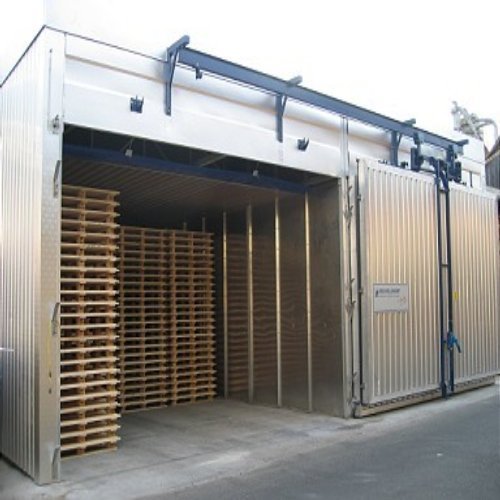
At WUDPAC, we operate a fully-equipped, in-house treatment facility that performs both Heat Treatment (HT) and Methyl Bromide (MB) Fumigation to the highest ISPM 15 standards. Every piece of wooden packaging that leaves our facility is IPPC-stamped and documented for smooth customs clearance worldwide.
Our treatment processes are carried out under strict supervision with calibrated equipment, ensuring consistent quality and full compliance with the importing country's phytosanitary requirements.
Using untreated or non-compliant wood packaging in international trade exposes your business to serious risks. Here's what can happen if your packaging fails to meet ISPM 15 standards:
Customs authorities at the destination port can reject, quarantine, or hold your entire shipment if the wood packaging is found non-compliant, causing significant delays.
Non-compliant packaging may need to be re-treated or replaced at the destination, incurring unexpected costs for fumigation, storage, and handling.
In severe cases, authorities may order the destruction of untreated wood packaging along with potential damage to the cargo inside, leading to total loss.
Repeated non-compliance can flag your business with trade authorities, making future shipments subject to stricter inspections and longer processing times.
Every batch of wooden packaging passes through our rigorous, standardised treatment process to ensure 100% ISPM 15 compliance:
Incoming timber and wood materials are carefully inspected and graded to ensure only sound, export-suitable stock enters the treatment process.
Wood is placed in a controlled kiln chamber and heated until its core temperature reaches 56°C for a minimum of 30 consecutive minutes, eliminating all wood-boring pests and larvae per ISPM 15 requirements.
Where required by the importing country, packaging undergoes Methyl Bromide fumigation under controlled conditions in sealed chambers, ensuring complete pest eradication.
Compliant packaging is branded with the official IPPC / ISPM 15 mark including our facility registration number, treatment type, and country code for customs verification.
Each treated batch is verified against load-bearing and dimensional specifications, documented, and securely prepared for dispatch with full compliance paperwork.
Both methods eliminate pests from wood packaging, but they differ in approach and acceptance. Here's a quick comparison:
Recommended for most export destinations.
Applied when required by the importing country.
Heat treatment (HT) is a process where wood packaging materials are heated in a controlled chamber until the core temperature reaches 56°C for a minimum of 30 consecutive minutes. This eliminates wood-boring pests, insects, and larvae, making the wood safe for international trade as per ISPM 15 standards.
ISPM 15 (International Standards for Phytosanitary Measures No. 15) is a mandatory international standard adopted by over 180 countries. It requires all wood packaging materials used in international trade to be treated and marked to prevent the spread of invasive wood-borne pests across borders.
The wood core temperature must reach a minimum of 56°C and be maintained for at least 30 consecutive minutes. This temperature and duration combination is proven to eliminate all known wood-boring pests and their larvae.
Methyl bromide (MB) fumigation is a chemical treatment where wood packaging is sealed in a chamber and exposed to methyl bromide gas under controlled conditions. It is an alternative to heat treatment and is specifically required by certain importing countries.
Heat treatment typically takes 2-4 hours depending on wood density and moisture content. Fumigation requires 24-48 hours including gas exposure and aeration time. At WUDPAC, we offer quick turnaround to meet your export deadlines.
Over 180 countries accept ISPM 15 compliant heat-treated wood packaging, including USA, EU member states, UK, Canada, Australia, Japan, China, India, and most nations in the Middle East and Africa. Some countries specifically require methyl bromide fumigation in addition to or instead of heat treatment.
The IPPC stamp is an official mark branded onto treated wood packaging. It contains the IPPC logo, country code (IN for India), facility registration number, treatment type (HT for heat treatment, MB for fumigation), and debarking status (DB). This mark verifies the packaging has been properly treated and is accepted by customs authorities worldwide.
No. Untreated wood packaging is prohibited in international trade under ISPM 15 regulations. Shipping untreated wood packaging can result in rejection at the destination port, quarantine, mandatory fumigation at high cost, or even destruction of the packaging and potential damage to the cargo.
Look for the IPPC/ISPM 15 stamp branded on the wood. It should include the IPPC logo, a valid country code, a facility registration number, and the treatment code (HT or MB). If your packaging lacks this stamp or the stamp is illegible, it will likely be rejected at customs.
After treatment, you receive an official Treatment Certificate documenting the treatment type, date, batch details, and facility registration number. This certificate, along with the IPPC stamp on the packaging, serves as proof of compliance for customs authorities.
Whether you need heat treatment, fumigation, or both — our team is ready to ensure your wood packaging meets every importing country’s requirements. Get in touch for a quick quote.